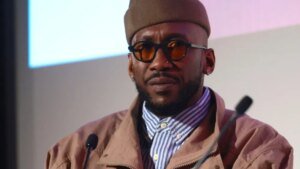
Richard Gere originally turned down the part of Bosko, the CIA’s London bureau chief in Paramount+ series “The Agency,” he tells Variety.
It was only after showrunners Jez and John-Henry Butterworth re-wrote the part following extensive notes from Gere that the screen icon agreed to come on board.
The show, which stars Michael Fassbender as an undercover operative who has trouble adjusting to civilian life, is an adaptation of French Canal+ series “Le Bureau des Légendes” by Éric Rochant. Jeffrey Wright and Jodie Turner-Smith also star in the U.S./U.K. adaptation.
According to Gere, fans hoping to see more of Bosko’s backstory in Season 2 are set to be disappointed. But the actor says he enjoyed leaning into his role as bureau chief, referring to himself in the third person when he told the cast and crew: “When I walk in the room, I’m the boss. I don’t demand that — Richard Gere does not demand that — but when Bosko walks in the room, he’s the boss, and everyone has to acknowledge that.”
Read more from Variety‘s interview with Gere below.
What are we going to see of Bosko in Season 2?
I don’t even remember, to tell you the truth. It was so long ago, honestly. I don’t remember.
When did you finish shooting it?
The second one we finished in — was it last September, I think, we finished?
Do you remember if we’re going to see a bit more backstory from Bosko?
No, I don’t want – no. There was stuff originally written that I wasn’t — I didn’t originally want to do this [show at all], and they [the writers/producers] said, “Well, what can we do to make you want to do this?” And I said, “Well, OK, let’s really think through this.” I said I don’t want a backstory with him, I don’t think it helps. I think it’s better if we don’t know much about him. We only know him by what we experience with him, not because we’re told things about him, or that he had a wife, or he has kids, or blah blah. To me that’s irrelevant in terms of this storytelling. He’s only in that office.
Why didn’t you want to join “The Agency” initially?
I was open to it, I just didn’t think that — I thought it was well written, but I didn’t think the character was that interesting to me as originally written. The French original, “Le Bureau des Légendes,” I thought was a terrific piece. My wife and I watched — I think we watched almost all of that together. But in terms of me, I wasn’t particularly interested in the character they had written, so it was a process we went through.
Did you sit down with Jez Butterworth and talk about the character?
We Zoomed, we had Zoom talks, and you know, I was kind of blunt with him. I said, look, it feels like a stock character, the way you’ve written it, and it’s not very interesting. So they started asking, “What would be interesting to you?” And I just started riffing on it, and they’re very responsive to actors. There was a lot of things, some were big, some were small, that I kind of went “Mmm.” And they would come back to me with something that was beautifully done and much more interesting than what the original solution was to the problem of storytelling.
Did those Zooms continue over Season 2?
No. We spoke, and sometimes it was just through the director or through the producer or whatever, “We need to work on this aspect.” It was always turned around really quick.
Was Jez on set for Season 2?
I don’t remember him being on the set, no.
How does Bosko vary from the French version Henri Duflot (played by Jean-Pierre Darroussin)?
It’s a different kind of character, [the French version] is much less of an alpha personality. He’s just different, I’m not going to characterize it. I said there was no point in me doing it exactly the way it was done in France.
It’s interesting how international adaptations reflect cultural differences. An American CIA bureau chief would usually be depicted as more of an alpha presence than perhaps their European counterparts.
Well, you’re dealing with much more resources, much more power, much more reach. I mean, what is available to a station chief in the CIA — and in fact, an important one, like London, which controls all of the former Soviet states, as well as the Middle East, goes into Africa — I mean, it’s just like it’s a massive office. I remember when I came to the set the first time, on the sound stages outside of London. I had imagined a little more down-home office and I walked in, and this is like Apple corporate — a massive building, high-tech, huge offices, hundreds of office workers and agents. And my own office. I had imagined a little more cuddly office, and it was this very high-tech [set], and it took me a little bit adjusting to see that. But the truth is, this is American power.
Did you speak to real CIA agents to prepare for the role?
Yeah, I’ve known I’ve known CIA agents and Secret Service guys for decades, so I know the territory and big shots in that world, and it’s a balancing thing. They’re real people, they have real relationships, and they’re goofy, and you know, they like sports and argue about sports, and they have quirks and odd things, and at the same time they’re dealing with power structures, but they’re dealing a lot with power structures that are in flux. You get a president for four years or eight years max, and a change – Republicans are in power, the Democrats are in power, it all changes — but this under-the-skin world of spooks, of agents, is international. That maintains. It doesn’t matter who’s president or prime minister or chancellor, this world under the skin is always there, and it doesn’t go away.
Do you see any similarity between what you do as an actor and what an agent in the field does?
Yeah, well, I think I think it’s why stories of cops, stories of spies, stories of these guys, their world — there’s always violence on the edge of it, there’s always a center of who’s telling the truth, who’s lying, “Do I even lie to myself?” that you have to be very much intuitive in terms of psychology and emotions and spirit, all those things. You have to read the room and read people very quickly and very accurately. At the same time, you have to be a top professional, you have to be skilled, you have to be able to get in and out of trouble quickly. And you have to have the big picture of saying “No, I can get out quickly out of this exit, but that’s not going to take me where I want to go. It’s going to be more difficult going here, but that’s the outcome that’s going to be best for all of us.”
I’m just laughing because there was a moment early on when I first started shooting that I said, “Look, guys – ” I was talking to all the other actors and the director and everything – “When I walk in the room, I’m the boss. I don’t demand that — Richard Gere does not demand that — but when Bosko walks in the room, he’s the boss, and everyone has to acknowledge that.”
I don’t have to make myself the boss. It’s a given in the situation. Whether you play the king, you play the president, whatever, you don’t have to go in and say “I’m the king” — no, it’s a given within our structure. There is a pecking order, and it’s clear.
This interview has been edited and condensed.
About The Author