Does a filmmaker have a responsibility towards marginalized communities? It’s an irreconcilable debate given the unbridgeable chasm between the two sides: Is the onus on the artist, or the audience? Edoardo Gabbriellini’s “The City of the Living” is a beautiful, heartrending film that sensitively builds a multifaceted character as real as any you’ll see, his flaws reinforcing rather than deflecting from the sympathy we feel for him, his girlfriend and his parents. Of course it’s impossible to imbue every role with the same three-dimensionality, yet there’s a problem when the most vile people imaginable become reduced to just two things: psychopathic behavior, and queerness.
Most Italians already know what’s coming. Luca Varani, 23, was a working-class regular Roman Joe forging his own way in life when he was sadistically murdered 10 years ago by a couple of drugged-up gay men whose brutality was so shocking that Gabbriellini thankfully condenses the horror, only hinting at the bloody carnage left behind. On the surface, the gay angle isn’t a problem — only a fool would suggest there’s any difference between a gay or straight psychopath, and this was a real event after all, loosely based on a true crime novel by Nicola Lagioia. But for those concerned about the paucity of positive gay representation in Italian media, and the vastly underreported levels of homophobic aggression throughout the country, it’s impossible not to feel frustrated that the only attribute accorded the murderers is their sexuality. For a film as perceptive as this one, so attuned to its protagonists, this blind spot feels disheartening precisely because we feel so emotionally invested in Luca’s well-being.
It’s likely the problem won’t even register with most audiences, and there will always be those arguing that “based on a real story” absolves everyone from any liability. But the controversy surrounding Buffalo Bill and “The Silence of the Lambs” hasn’t gone away, and it’s even more inescapable in “The City of the Living.” Had Lagioia’s largely excellent script, adapted from his book, included even a minor positive gay character, there would be nothing to complain about. Instead, we’re presented with deviant men defined only by their fetishes, creating an uneasy imbalance that’s impossible to ignore. Were this a bad or even mediocre film, it would be easy to dismiss, but the truth is Gabbriellini has made his best movie to date, one that wisely refuses to theorize, plunging us without judgment into the life of its deeply sympathetic protagonist.
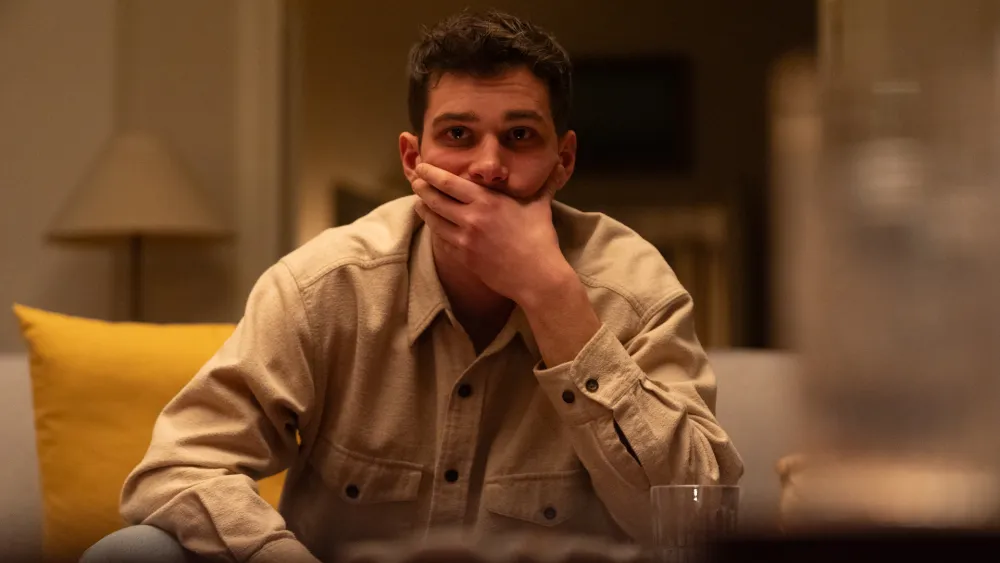
Luca (a superb Emanuele Maria Di Stefano) is loved, joyously, by his adoptive parents Silvana (Simona Senzacqua) and Giuseppe (Valerio Mastandrea). The family lives in a nondescript neighborhood on the outskirts of Rome, forming part of what New Yorkers would call “the bridge and tunnel crowd” who occasionally come into the city center but don’t engage with its urban diversity. Luca works with his dad on the gewgaw truck they own, selling brightly colored knickknacks and candies along roadsides and itinerant amusement parks, and he’s also in night school to finish his high school degree, though he’s bored witless.
Among the film’s many strengths is its focus on character rather than explanation; information isn’t spoon-fed, and background relationships and dreams are organically conveyed through interactions. A perfect case in point is an early argument between Luca and his girlfriend Marta (Gaia Merlonghi, excellent); the immediate reason for the fight is irrelevant — it’s about the selection of a restaurant — but the dynamic reveals much about their relationship and the roles Italian men and women tend to follow. They patch things up, he drops out of school and starts looking for a job so he and Marta can move in together.
Luca’s willing to work, but accumulating savings isn’t his style, and he needs money if he’s going to rent an apartment. A chance meeting near Rome’s Termini station with Andreas (Andrea Isidori), a gay-for-pay escort, opens up a world of easy money without having to do much more than wank or watch, and while an earlier encounter hints at the possibility that Luca’s sexuality isn’t completely fixed, any potential same-sex attraction is embryonic, at best. Andreas brings him to a rich guy’s place, where Luca catches the eye of a flamboyant coke-snorting crossdresser whose affect radiates malevolence.
Lagioia’s book goes into disturbing detail about what came next; suffice it to say that Luca’s murder tested the bounds of sadism. Gabbriellini prudently swerves away from all that, instead ensuring that Luca’s life is the focus, and then the lives of his loved ones, destroyed by the tragedy. We don’t learn why the two murderers inflicted such evil, and frankly such darkness outside the bounds of humanity has no explanation. In the film they’re creepy, kinky and gay, and while we don’t need any more from them, we do need some sign that being queer is not only associated with malignancy.
In the film’s pressbook, the director states, “Cinema, like literature, has the great power of empathy and thus the ability to lead us to see through a lens that, if properly focused, avoids any facile or preconceived judgment.” For Luca and his loved ones, he’s followed that dictum to the letter, and the immigrant community briefly seen with Luca at night school is also included within that humanizing focus. But Gabbriellini forgot that the gay community, routinely demonized, also needed at least a scrap of empathy, not towards the sadists, who deserve no such lens, but the vast majority of queer people who also form the fabric of humanity. As painful as it is to write this, there is recompense in the film’s strengths, and the heartbreak we feel as Luca’s parents and Marta face the unspeakable nightmare of the murder, and the vacuum left by his absence.
About The Author


