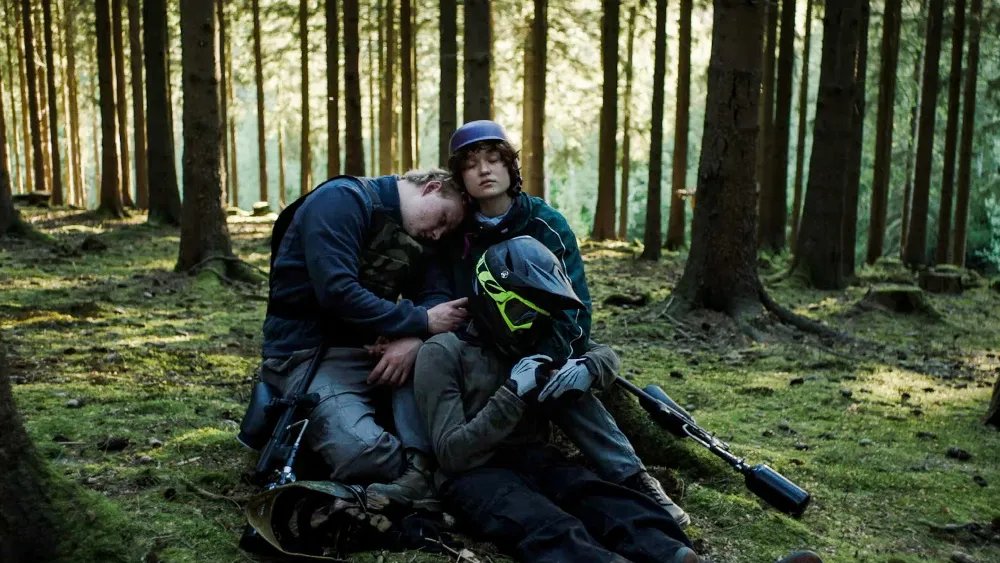
Three teenagers, unclothed, stand close to one another in a forest, gently caressing the wounds they have inflicted on one another. This is the climactic moment in “Oasis,” a film that at times feels like a Grimms Brothers fairytale, and, at others, an all-too-real vision of modern-day youth in crisis.
If you were told that the German director, Jannis Lenz, was tutored by Jessica Hausner and was an assistant to Michael Haneke, then you’d get a sense of the influences at play in the film — his debut feature — which has its world premiere on Sunday in the Horizons section of Venice Film Festival.
While Lenz acknowledges the influence Hausner and Haneke have had on him, he is keen to state he has his own approach to filmmaking. “It would be strange if [the time spent with them] wouldn’t have left an influence. But the way we work as filmmakers is very different, and the final results too. I think my way of working is much more open. I try to have more openness with the actors, with improvisation,” he tells Variety.
He does, though, share his mentors’ love of “precision,” he says. In his case, this is mainly evident during the preparatory stage. “I prepare myself very precisely, otherwise it would be chaos later on,” he says. However, once the filming starts, you should “be willing to let yourself be surprised,” he says.
The film begins with Andy, a newcomer to his high school in Southern Germany, being caught on camera threatening other students, and as a result he is faced with expulsion. His only friend is Lukas, the son of a teacher at the school, with whom he escapes to the forest where they engage in paintball combat.
For the boys, the forest is “a place where they can retreat to,” says the director. Here, they find “some kind of a space that isn’t part of a rigid system.”
As pressure builds on Andy from the other students, their parents and the school staff, he and Lukas find an unexpected ally in Maya, who attends a different school — one that specializes in music and the performing arts.
While the boys had previously indulged in cliched displays of machismo, Maya helps them explore their vulnerability and sensuality, while at the same time participating in rituals of physical injury and pain inflicted by them on each other.
“Andy and Lukas build a traditional boyhood kind of friendship, and then Maya comes in. She brings in something very different. She brings in her own vulnerability. More and more they open up and these rituals develop. They build this safe space where they can show their wounds [both physical and psychological] and find some kind of healing for themselves, where they can feel seen and be who they are, being able to show their weaknesses.”
The “Oasis” of the film’s title isn’t the forest, Lenz says. “It’s not a geographical place. It’s more something they create by themselves, by their togetherness, and by the trust and safe place they build together.”
The director encouraged his young actors to feel their own way into the scenes in the forest, which they did with the help of an intimacy coordinator. The idea was to allow the actors to build trust with each other and the director.
“I think these were very demanding scenes, so it was very important for me to bring them and their own ways of seeing it in,” Lenz says. “We started on a theoretical level, just reading the scenes and talking about it, building up trust with each other, and also trying to understand our personal reading of what we will develop here, and then, in the next step, when it got physical, I brought in an intimacy coordinator, who helped us a lot on how we can go on with that.
“And it was very beautiful because when we had the first rehearsal, it was in a classical rehearsal room, so nothing very special. But when we left this theoretical stage and moved over to the physical stage, there was already such a big trust toward each other. So, they were not talking at all; they were just moving and touching with the hands, and asking questions with their eyes, like, ‘Is that okay? Can I move further? Should I stop? Something like this?’ And that was very touching for me to see that what we’ve worked out on a theoretical basis worked so well in a physical way. That was for me the moment when I really felt that we are onto something that’s worth sharing with other people.”
Before he and his co-screenwriter and cinematographer, Alexander Dirninger, entered production, they set themselves various restrictions. For example, they chose to use as little dialogue as possible, forcing their actors to communicate non-verbally as far as possible, which adds an extra charge to every look, expression and touch.
In the production notes, Lenz mentions that he grew up close to the site of the Winnenden school massacre in 2009. “The questions it raised — about fear and exclusion, about what happens to young people who can’t find their place — never fully left me,” he says. But anyone expecting to find a “birth of a killer” narrative will be disappointed. The film is far more subtle, nuanced and ambiguous than that.
“Oasis” includes a scene in which an instructor in anti-violence techniques is brought in to help de-escalate the tensions, and another where a councillor encourages Andy to discuss the issues he’s facing. Both suggest that German society is trying to adopt new ways to lower the temperature. And Lukas’ father is at pains to cope with the situation without resorting to archaic methods of patriarchal control.
The parents of the other students are keen to press for the exclusion of Andy. “What drives them is fear,” Lenz says. “Fear that something will happen to their children.” He adds, “The way they are behaving and the way they are dealing with the situation isn’t ideal, but it was very important for me to take each and every person in the film seriously — to understand their motivation, why they are behaving like that — and not to judge them and not to have something like the good guys and the bad guys.”
About The Author


