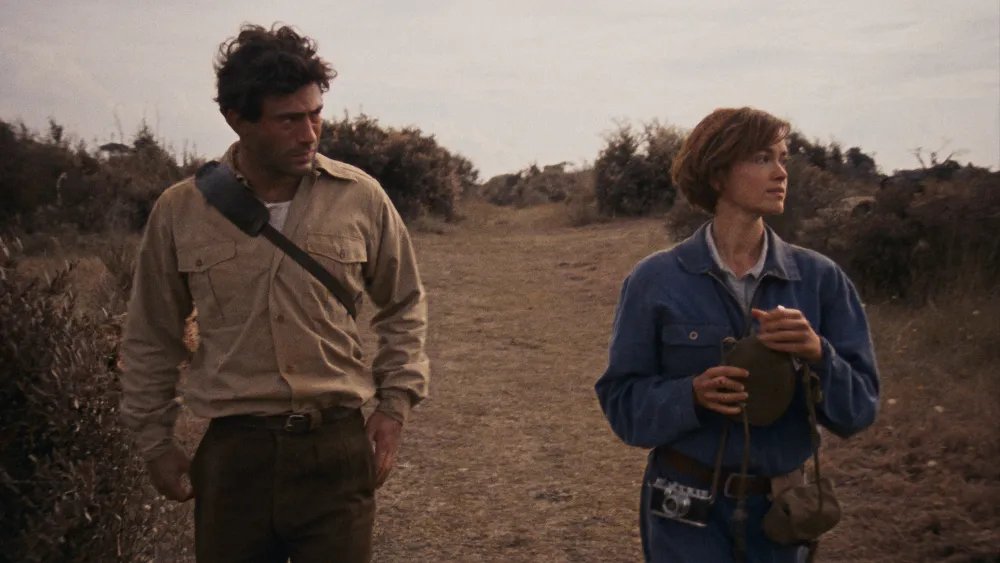
Gerda Taro was only 26 when she became the first female photojournalist to be killed on the battlefield. It would be decades before her true contribution to the artform was acknowledged. Alina Marazzi’s “The Girl With the Leica,” which opens Venice’s Horizons section, seeks to redress this oversight, and pays tribute to Taro’s vivacious personality.
Marazzi was already acquainted with Taro’s work when Helena Janeczek’s novel about the photographer came out in 2018. Soon after, the two of them met to discuss how the story could be adapted for the cinema. The screenplay was written by Marazzi with Valia Santella, with the part of Taro taken by Emilia Schüle, best known for the lead role in “Marie-Antoinette.”
The greatest change that Marazzi made was to tell the story from the point of view of Taro herself, whereas the book had told her story through the recollections of three of her friends, as they meet in the 1960s, looking back at her life.

“The Girl With the Leica”
Courtesy of Vivo Film, Komplizen Film, ZDF/Arte, Eolo Film Productions
The film, on the other hand, centers on July 14, 1937, which is Bastille Day in France, a day celebrating freedom. Taro is seen meeting in Paris with her friends, including her lover and fellow photojournalist Endrè Friedmann, as she prepares to return to Spain to report on the Civil War.
Through flashbacks, the film shows how Taro, who was born Gerta Pohorylle, came to meet her friends, some of whom she had known in Leipzig when they had been left-wing activists, eventually fleeing when the Nazis took power.
In Paris, she develops an interest in photography and joins forces with Friedmann, with whom she invents the persona of American photographer Robert Capa, as a means of selling their work to the U.S. market. Many of her photographs were attributed to Capa, which obscured her contribution once Friedmann adopted the name for himself alone.
“The Girl With the Leica”
Photo by Manuel Alberto Claro, courtesy of Vivo Film, Komplizen Film, ZDF/ARTE, Eolo Film Productions
Through Taro’s eyes, the film takes in the cultural and artistic milieu around her in 1930s Paris, and in particular the community of émigrés from Eastern and Central Europe. These refugees often had to adopt new roles in order to survive. Among Taro’s circle were Fred Stein and David “Chim” Seymour, who both became leading photographers. Photography, as well as being a means to earn a living, also enabled them to develop a “visual language” and “express their vision,” Marazzi tells Variety as she prepares to debut her film in Venice.
Seymour, born Dawid Szymin, went on to set up the pioneering photo agency Magnum in 1947, along with Capa and Henri Cartier-Bresson, among others. Like Taro, both Seymour and Capa died while on assignment, a reminder of the dangers of photojournalism. Three boxes of photo negatives, taken by Taro, Capa and Seymour during the Spanish Civil War, went missing in 1940, and were only rediscovered in 2007 – after which it was possible to take stock of Taro’s role in the development of photojournalism.
In developing the view of Taro’s personality, as well as drawing on Janeczek’s novel, Marazzi leant on the first ever biography of Taro, written by German historian Irme Schaber. This added details of Taro’s political engagement in 1930s Germany, where she – along with other left-wing friends such as Georg Kuritzkes – opposed the rise of nationalism.
The film also gives an insight into her motivation for travelling to Spain during the Civil War, “hoping for a better society,” as Marazzi puts it.
The film details the deprivation of everyday life for Taro and Ruth Cerf, another friend from Leipzig, when they first arrive in Paris. But despite the hardship, the mise en scène presented is far from bleak. It is a view of “young, simple, penniless people who like to have fun and enjoy life,” Marazzi says.
As well as her political commitment, the film focuses on the “light-hearted” side of Taro. It shows Taro and her friends living life day by day, engaging in romantic affairs and strong friendships.
“She was a young, lively, pretty, seductive woman, so she’s not giving up her personal life in order to become a strong, politically committed photographer,” Marazzi says. “It’s the combination of these two aspects that I thought was important to tell.”
She adds, “I think it is part of life when you are in your 20s. You are not just a two-dimensional character who only believes that you have to go and fight for a better world.”
Marazzi didn’t want to create a “proper period piece,” so the actors speak in a contemporary way. “As a woman, Gerda comes across as a very contemporary figure in the way she is trying to define her identity. She is finding out about herself as she goes along.”
To emphasize Taro’s sparkling personality and the emotions that are roiling inside her, the film evokes visual imagery such as fireworks exploding in the background to celebrate Bastille Day and some vivid red flowers given to her by Friedmann. Marazzi says she let herself “be seduced by the beauty of the imagery,” and adds that she was also “influenced by the experimental and avant-garde cinema of the 1930s.”
The film’s contemporary relevance is clear, in the filmmaker’s view. “There are many similarities between the 1930s and now, with the rise of right-wing nationalism reminding us of this time,” Marazzi says. Added to that, “the involvement of journalists in conflicts like Ukraine and Gaza can be traced back to the Spanish Civil War,” she says. Now, as then, journalists are highlighting that “democratic values are at stake,” she says. Marazzi also points out that “many media people have died” in both conflicts. “If Gerda was alive now, she would probably be travelling to one of those two places,” she says.
About The Author


