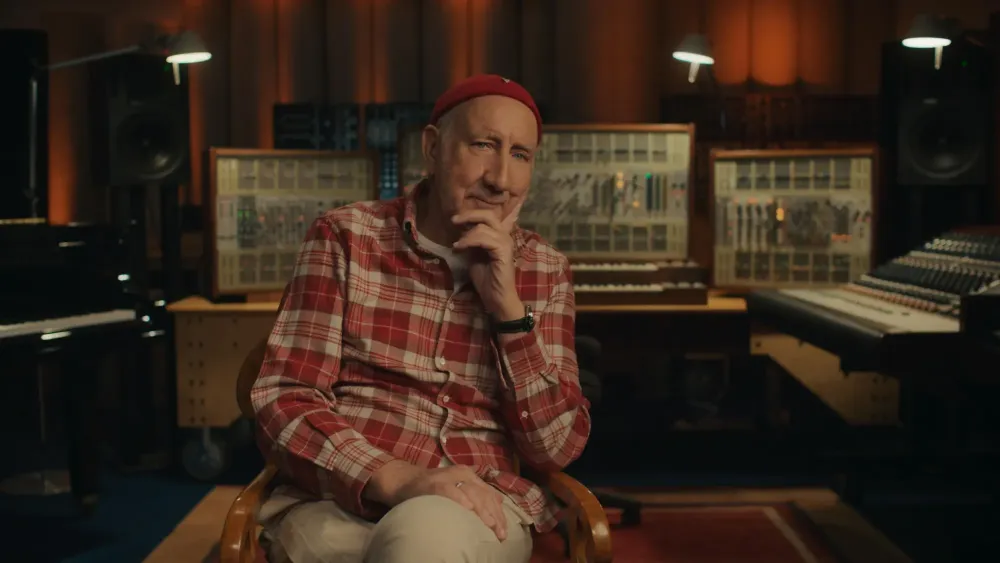
Every rock god has his ultimate gesture of power, and for Pete Townshend it was not the way he liked to smash his guitar (though that came close). No, the quintessential Townshend power sign was his giant circular windmill strum, arm outstretched and twirling, gathering centrifugal force to slam that pick up through the guitar strings, creating the loudest chord humanly possible.
The impulse behind that gesture — the destructive fury of it — is the same one that gave rise to Led Zeppelin and punk. And you get to see Townshend do it a bunch of times in Frank Marshall and Nigel Sinclair’s “Pete Townshend: Behind Blue Eyes,” the lively and somewhat scattered documentary that just premiered at Telluride. As music docs go, it’s a serviceable rock ride, with plenty of great archival footage that’s never been seen before. (It’s been culled from long-lost 16mm reels shot at Holmhurst Manor in 1972, as well as Townshend’s home movies and outtakes from the Who’s 1970 Isle of Wight performance.)
But the power-chord side of Townshend ends up taking something of a back seat in “Behind Blue Eyes.” The movie is more interested in his anguished moody poetic side, the one that created the great rock opera “Tommy” (a work nearly as pivotal as “Sgt. Pepper,” and one built around Townshend’s childhood trauma), as well as his desire to expand beyond it by making rock over into something bigger, bolder, more confessionally grandiose.
Townshend was a Mod who grew up into a rock intellectual who still talked like a bloke. He’s incredibly thoughtful, and always has been, but he could also be something of a doomy drama queen. He led the early Who with burn-it-all-down ferocity, yet was always concerned about the effects of rock, wanting it to stay positive. The film sketches in how Townshend got his start in art school, and in his case it really stuck. He wanted rock to be an art form. He swiped the idea of guitar-smashing from films he was shown as a student of avant-garde classical musicians destroying pianos. His days with the Who began as a lark (he never planned to make a career of it), but the group became a draw in West London. There’s a great clip of them from 1965 playing “I Can’t Explain,” with its tight chords that were so ’50s yet so new, as Townshend bops out to it.
It’s strange, though, that “Behind Blue Eyes” skips over the epochal moment of “My Generation,” one of the 10 most seismic and influential songs in the history of rock ‘n’ roll. When punk finally came along, the movie talks about how Townshend, who totally dug the punk scene, tried to cozy up to Johnny Rotten and got nowhere. It notes how much influence the Who had on punk — but that would be “My Generation,” which the film never got around to mentioning!
Other jarring omissions: We’re informed that Keith Moon, the Who’s thrash genius of a drummer, died of a drug overdose (the drug was chlomethiazole, a sedative prescribed to alleviate the symptoms of alcohol withdrawal), but the movie never says a word about his drinking. (He might have been the biggest drinker in the history of rock.) And while we’re told that Townshend was dead set against making a movie of “Tommy,” the film leaves out the impact of Ken Russell’s opulently feverish 1975 big-screen version.
There’s already a definitive movie about the Who, the formative rock doc “The Kids Are Alright” (1979), so Marshall and Sinclair may have felt that they could sort of skip through the band’s career. Yet “Behind Blue Eyes,” though it is a film about Townshend, remains very, very Who centered. Townshend, who’s 81 now, sits for an extended interview, wearing a red wool cap over his bald head. He is open and circumspect, with a disarming gentleness. He tells the Who’s story — as does Roger Daltrey, who sat down for the filmmakers — with a ripe feeling for the heights they scaled and a wistful sense of how far away the feuds and valleys now seem.
“Behind Blue Eyes” opens, quite dramatically, on the crisis Townshend was going through after “Tommy” became a majestic success. Townshend had evolved his whole idea for a rock opera out of the two years, starting at age four, when he was abandoned by his parents and sent to live with his sexually debauched grandmother. He was never abused, but he says he was so distraught that he literally tuned out reality; he became that “deaf, dumb and blind kid.” Townshend composed and recorded the music for “Tommy” at home (in demos that were then built on in the studio). The band, at that point, had become entirely his. (He says the other three band members just wanted to party and sleep around.) But once “Tommy” changed the game for the Who, how could they top it? In films from the time, we see the fear frozen onto Townshend’s face.
The Holmhurst Manor footage shows the members of the Who sitting around the Jacobean country house in East Sussex that was purchased by Roger Daltrey in 1970 (it was one of those aristocratic estates that noise-making British bands of the ’70s loved to record in), hashing out where they were going to go next. Because they had no idea. And we see the chaos they were feeling. Success had left them stranded, creatively, the same way that U2 were before they pulled themselves together to go in a new direction and make “Achtung Baby!” We also see how testy and difficult Townshend could be. That can happen when you’re the leader who doesn’t know where to lead. Watching this footage, I kept wishing that someone had made a Townshend biopic 30 years ago starring the young Ralph Fiennes.
But, of course, the Who pulled through and found a new level of sonic triumph. I’ve often gone easy on the hagiographic side of music docs, and the reason is simple: While I prefer to get the full picture, if a movie plays down the dark side of an artist, but captures that artist’s music and career with vibrant appreciation, that can be enough to make an enlightening and captivating film. But “Behind Blue Eyes” may be a special case. The movie centers itself on Pete Townshend’s contradictions, his growing pains, his turmoil, and his complexity as a human being and rock artist. And that’s all good. But given where it sets the bar, there’s too much left out.
We learn a great deal about Townshend’s struggle to make “Lifehouse,” an unfinished science-fiction rock opera that he became obsessed with to the point that it starts to sound like something out of “Spinal Tap.” But we learn virtually nothing about Townshend’s close relationships, notably his two marriages. In 1980, when “Rough Boys,” his first solo single, was released, Townshend gave interviews acknowledging that he had, for a time, led a gay existence. Why isn’t that in the movie? And though we hear the gritty addiction details of Townshend’s dark period (when he’d become a junkie and was, by his own description, drinking three bottles of Cognac a day), what I wanted from the documentary wasn’t a bottoming-out-and-getting-sober narrative. I wanted the movie, and Townshend himself, to go deeper into why he descended into addiction.
As a rock biography, “Behind Blue Eyes” is “exploratory” yet fuzzy. It’s not as riveting a portrait of the Who as “The Kids Are Alright” was (though there’s consistently great stuff in it), and for all its confessional aura it doesn’t leave you feeling that you truly know and understand Pete Townshend. It’s more like you’ve glimpsed him around the edges, without quite touching the bad man, or the sad man, behind blue eyes.
About The Author


