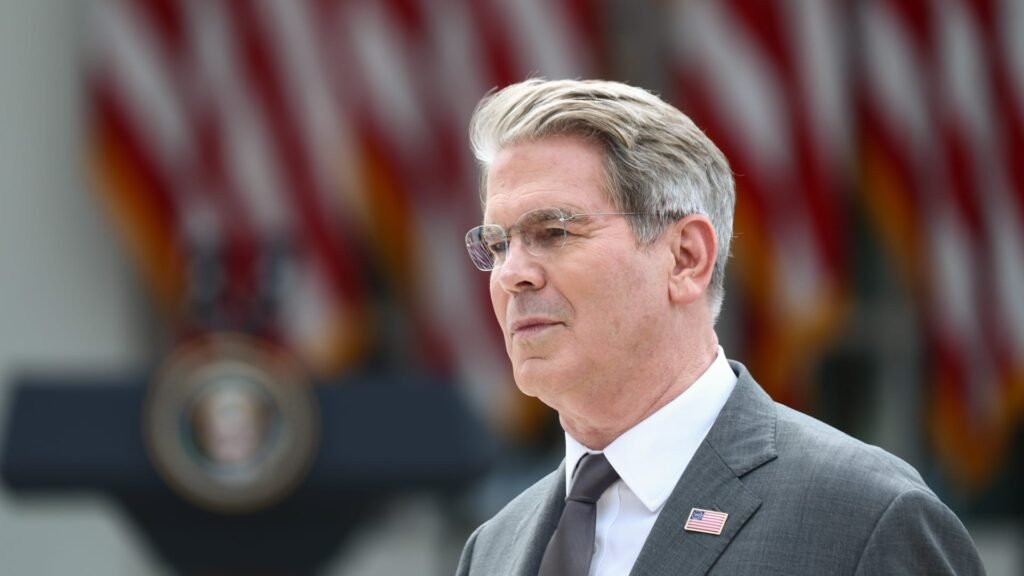
WASHINGTON, DC – AUGUST 20: U.S. Treasury Secretary Scott Bessent attends an event announcing the expansion of a foster care initiative in the Rose Garden of the White House on August 20, 2026 in Washington, DC.
Finn Gomez | Getty Images News | Getty Images
The U.S will unveil “the single greatest financial offensive ever” against Iran on Monday, Treasury Secretary Scott Bessent said, while Tehran threatened to seize vessels that violate transit rules in the Strait of Hormuz.
The looming escalation comes as both sides missed a 60-day ceasefire window to reach a deal, closing off the formal truce mechanism aimed at ending the Middle East war now in its sixth month.
In a post on X Sunday evening stateside, Bessent said “at dawn begins an economic D-Day,” framing the coming measures as the “endgame” for Washington’s campaign against Tehran.
The new measures will add to an extensive sanctions regime already targeting Iran’s banking, energy, aviation and cryptocurrency sectors. The Trump administration has claimed that Iran’s economy is in freefall, with runaway inflation and a collapsing currency.
While little is known about the specifics of new economic sanctions, the Iranian rial hit a new open-market low on Sunday, with the dollar surpassing 2 million rials, according to Gulf News.
Bessent also warned that “any nation that serves as a financial artery of a withering regime should expect to share in its isolation” — language aimed squarely at foreign governments still transacting with Tehran. He has previously warned of further secondary sanctions on nations and entities that conduct business with Iran.
Writing in the Financial Times on Sunday, Bessent added: “Iran’s enablers purchase and transport its petroleum. They facilitate the flow of its finances through exchange houses and free trade zones.”
“They welcome Iran’s flights and maintain registries on its behalf,” he added. “They turn a blind eye to seaborne fuel transfers and the illicit use of their banks, all while concealing the extent of their complicity.”
Iran has responded by warning Gulf neighbors against joining U.S. economic measures and tightening its grip on the chokepoint, through which roughly a fifth of the world’s seaborne oil passed before the war.
On Saturday, Mohsen Rezaei, a longtime military commander who became the new secretary of Iran’s Supreme National Security Council earlier this month, vowed to target the interests of oil-rich neighbors if they joined U.S. efforts to further isolate Iran.
“Any country that becomes a partner in creating economic restrictions against us will be regarded by us as an enemy,” he said in an interview with Iran’s state broadcaster.

In a series of posts on X on Sunday, Iran’s state-controlled Persian Gulf Strait Authority, or PGSA, warned that vessels violating its transit rules in the Hormuz could face penalties, including “fines, seizure, or confiscation” during future passages.
Iranian Foreign Minister Abbas Araghchi has also dismissed the threat of a fresh round of U.S. economic sanctions as a “desperate” ploy, asserting that U.S. actions, like the blockade, were set to fail.
Tehran’s parliament approved on Sunday a provision stipulating that ships passing through the Hormuz chokepoint will pay for services provided by Tehran, according to local media reports. The legislation still needs full parliamentary approval.
Omani Foreign Minister Sayyid Badr Albusaidi is scheduled to visit Tehran on Tuesday for bilateral talks with his Iranian counterpart Abbas Araghchi, local media reported Monday. Both sides will continue discussions over the Strait of Hormuz, according to Iranian foreign ministry spokesperson Esmail Baghaei.
Crude pulled back in Asian trading Monday despite the looming escalation. West Texas Intermediate futures, the U.S. benchmark, fell about 1.3% to $85.93 per barrel, and Brent crude, the international benchmark, dropped 1.3% to $93.22 a barrel.
The UK Maritime Trade Operations agency reported no confirmed attacks in the strait over the 48 hours to Sunday, though it warned of a “continued risk of drifting or uncharted mines,” with mine danger areas still active.
About The Author


