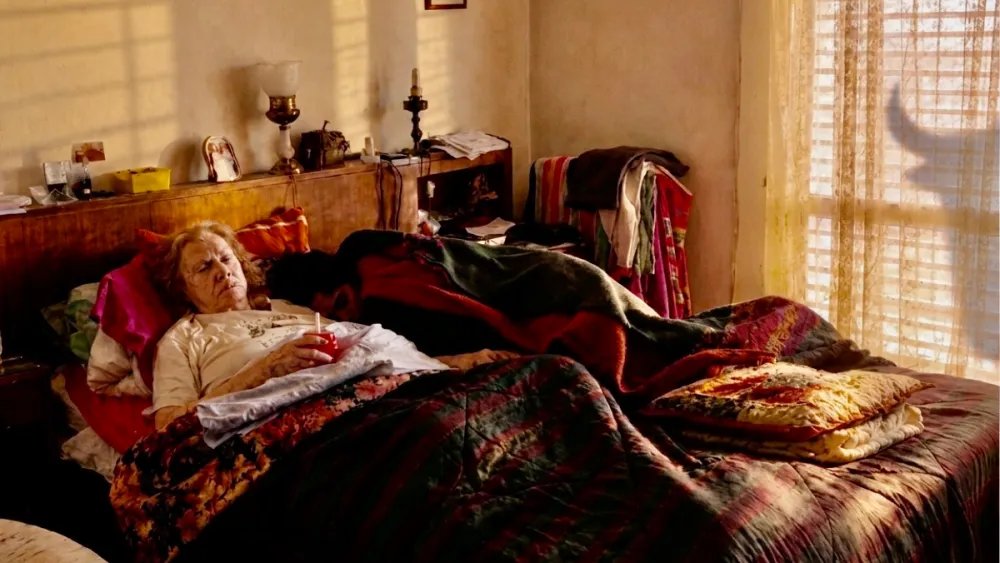
Among the 15 projects participating in the upcoming San Sebastián Europe-Latin America Co-Production Forum is “The Rehearsals” (“Los Ensayos”) by Argentina’s Celina Murga, best known for her Martin Scorsese-executive produced dramas ‘The Freshly Cut Grass’ and ‘The Third Side of the River’ and of course, her career-launching 2003 debut, “Ana and the Others.”
Based on various short stories by Japanese-Argentine author Alejandra Kamiya, “The Rehearsals” follows Eva, nearly 50, who goes along with her 80-year-old mother, a now retired prominent doctor facing the onset of Alzheimer’s. Eva’s family home is also shared by her teenage son and younger sister, who share in caregiving duties. Between small celebrations, hospital visits and disagreements about how to care for her, a mysterious presence of bulls begins to surround the house. Weaving everyday reality with the fantastic, the film explores vulnerability and how caring for someone can also bring love, connection and a renewed sense of life.
“The film reflects on the way our society looks at aging, deterioration and death. We live in a culture that rewards youth and productivity, making aging bodies and slowing time increasingly invisible. Yet confronting mortality can also open new forms of intimacy and a renewed perception of vitality. ‘The Rehearsals’ was born from the desire to make these experiences visible and to ask what we lose when we deny our finite condition,” Murga told Variety.
She plans to shoot the film in Uruguay by 2028 and will make use of its newly introduced audiovisual tax credit on up to 30% of eligible expenditures in the country.
Currently consolidating its international co-production and financing structure, the project counts on Uruguay-based Alterna Media, which will lead the local production. Alterna Media’s Maria Laura Berch, Joaquin Romero Vercellino and Lucia Vela serve as executive producers.
Founded by Berch and Romero, Alterna Media’s credits include “La noche sin mi,” co-produced with Tarea Fina and winner of the Best First Feature award at Argentina’s Premios Sur and “El mensaje,” winner of the Silver Bear at the Berlinale. This year, Alterna Media presented “La de Punta Carretas,” a series directed by César Charlone and Fernando Meirelles, at the Berlinale, in co-production with Federation and Ojo Films.
The Europe-Latin America Co-Production Forum will take place over Sept 21 – 23 during the 74th San Sebastian Film Festival.
Murga expands on her latest project and how Scorsese impacted her work:
Martin Scorsese chose to mentor you and executive produced “The Third Side of the River” and your last film to date, “The Freshly Cut Grass.” Are you still in touch with him? How has that experience shaped you and your filmmaking?
Yes, we have stayed in touch. In fact, he attended the Tribeca presentation of ‘The Freshly Cut Grass.’ He has a deep understanding of the challenges of making films in different parts of the world, particularly as a woman filmmaker. He is always attentive to what I’m doing – he emails me to ask about my projects and suggest new ones.
I value not only his place as an emblematic director in the history of world cinema, but also his human commitment and his profound understanding of cinema’s power within individual cultures and across the world.
That is what I treasure most from the experience, beyond the specific technical aspects I was able to observe while watching him work on set: a sense of mission, of why we make films and what they can mean and of how deeply that purpose can inspire others.
You say “The Rehearsals” is based on short stories by author Alejandra Kamiya. Did you mean you combined several stories into one? What drew you to these stories?
I combined several stories. The main one, ‘The Rehearsals,’ comes from ‘The Patience of Water Over Every Stone,’ but I also drew characters and situations from other stories in that book and from ‘The Fallen Trees Are Also the Forest.’ I was deeply struck by how these stories explore themes that interest me: the ambiguous, tense relationship between parents and children; humanity’s profound connection to nature; death as an inevitable part of life and the passage of time. I was also drawn to a narrative style that subtly shifts reality toward the fantastic. This coexistence of the everyday and the extraordinary suggested to me a cinematic way of approaching death – not as a spectacular intrusion, but as a presence that slowly infiltrates daily life.
Will the story be set in Argentina but shot in Uruguay because of its new tax credit? I assume that many Argentine filmmakers are going to Uruguay and elsewhere given the lack of state support in Argentina.
The story is set in Entre Ríos, Argentina, although its landscape and cultural context could naturally exist on the Uruguayan side of the river as well. Since the film is being produced by the Uruguayan company Alterna Media, Uruguay’s current audiovisual incentives have been an important factor in making the production possible. Beyond the economic dimension, however, there is a strong cultural and geographical connection between Entre Ríos and Paysandú that makes this collaboration especially meaningful to the project.
The current context is also encouraging us to think about film production in more regional terms. Uruguay has created a dynamic environment for audiovisual projects and we see these opportunities not as a replacement for Argentine production, but as a way to strengthen connections between filmmakers and producers on both sides of the river.I imagine the story unfolding in an emotionally essential territory for me: my home province of Entre Ríos, Argentina. Uruguay shares the same river border and I have always felt a very organic connection between the two.
The project also grew from my desire to work with Alterna Media’s María Laura Berch, with whom I have collaborated since my second film, ‘Una Semana Solos.’
What themes are you exploring in this project? Are there themes you have always gravitated to throughout your career?
The heart of ‘The Rehearsals’ is not Alzheimer’s itself, but care as an everyday practice and as an experience of accepting the cycles of life. The film follows a daughter trying to accompany her mother through her final stage, navigating the challenge of remaining close without denying the loss or imposing a particular way of experiencing it.
Through a restrained approach, I want the cinematic gaze itself to become an ethical question: How can we look at someone experiencing deterioration without reducing them to their fragility? How can we approach vulnerability without turning it into spectacle? The film seeks to hold that tension through a deeply human perspective, where observing can also become an act of care.
The film also reflects on how our society views aging, deterioration and death. We live in a culture that privileges youth, productivity and autonomy, while rendering aging bodies and slower forms of existence increasingly invisible. Old age has a political dimension that is rarely acknowledged: it confronts us with our finitude and with the fact that neither technology nor the market can buy permanence.
I want to make a film rooted in affection, far from both condescension and the aestheticization of suffering– a sensitive, human portrait centered on relationships, shared time, and our ability to accompany one another. More than a film about Alzheimer’s or death, I want ‘The Rehearsals’ to be, above all, a film about love.
About The Author


