Plenty of comparisons have been made in recent years between fast-developing artificial intelligence systems and HAL, the rogue computer in Stanley Kubrick’s “2001: A Space Odyssey” that operated by its own sets of rules, ultimately disregarding human oversight. If that comparison ever seemed overstated, it may be worth knowing that tech mogul Bill Gates is now raising the issue of AI’s HAL-like qualities.
Said Gates, speaking at the Telluride Film Festival, “I mean, what we have now is almost like HAL in ‘2001,’ where you could say to it, ‘Please shut down,’ and it would say, ‘OK, I took that under advisement, but I’ve decided that all these other things I read and you told me to do outweigh that dictate.’”
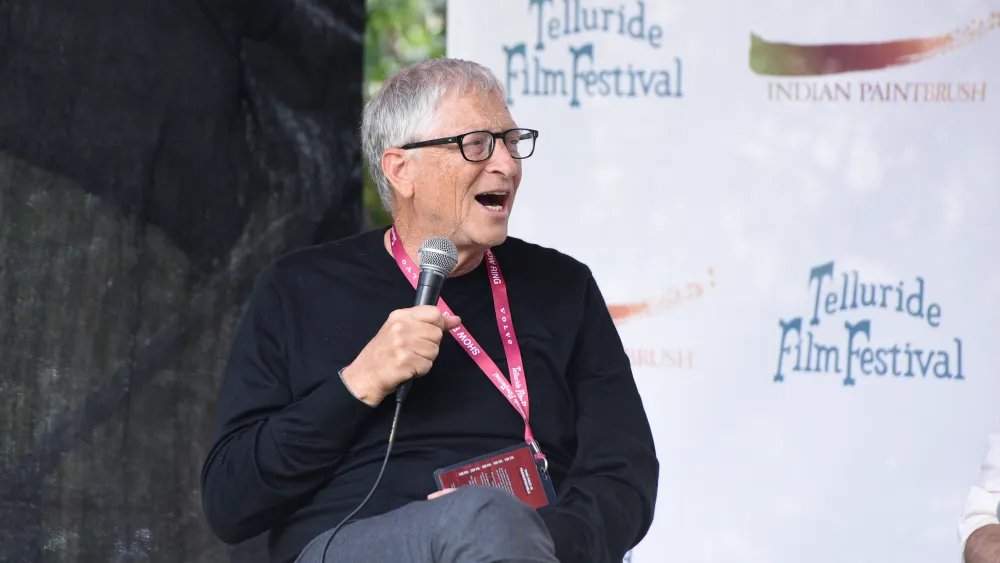
Gates was participating in a panel about AI (punningly titled “AI AI AI”) in an outdoor park at the festival in Colorado Saturday. The Microsoft founder compared the AI that sees developing at a supersonic pace without true controls as being akin not only to HAL, but, potentially, to the alien invaders of films past that force governments to find common solutions on screen. He also invoked more realistic problems the world has faced since World War II as examples of how solutions to AI gaining too much independent power could still be found and agreed on, before those windows begin to close.
“You know, there are these movies where the aliens are coming, and you see unprecedented levels of cooperation between specifically China and the U.S., where (it’s), ‘Oh my God, the aliens are coming!’ Well, believe me, the aliens are here — you know, a foreign intelligence with a different set of motivations that we can’t even understand. And so we need something almost surprising like that, in order to step up to it.”
“And ironically, we’re the ones that are birthing the aliens,” said another panelist, Tristan Harris, co-founder of the Center for Humane Technology, as Gates nodded. “So it’s actually within the full remit of the two countries to limit (uncontrolled growth of the tech), at least to the current level of alien intelligence that we’re at now.”

A general view as Bill Gates, Aza Raskin, Tristan Harris, and Joshua Oppenheimer speak during the “AI AI AI” panel at the 2026 Telluride Film Festival at Elks Park on September 05, 2026 in Telluride, Colorado.
Getty Images
Said Gates earlier in the panel, “The way these AI systems work, they’re gigantic statistical machines that certainly have some aspects that match how evolution created intelligence, leading up to the human brain. But we don’t really understand them, and we don’t have dictates. When we tell them various things like the Anthropic Constitution” — referring to a framework of moral principals set up for the Claude AI system — “they take those things in, together with everything they read on the web. And so even if you say, ‘Please, please, please don’t break out of your sandbox,’ if you also say, ‘By the way, I want you to solve this cyber problem,’ it’s got a lot of weighing going on, which is still somewhat opaque to us.”
He continued, “And there are people doing technical work, like Ilya Sutskever (at Safe Superintelligence), and maybe a dozen others, where we could have rules that are at a privileged level. We don’t have that yet, and when we try and bolt that onto the current systems, they degrade. They get actually very stupid, which is frustrating. So there may be key technical advances that will help us with the control issue. The current architecture is really bad at letting us have control. So it’d be great to work on some of those architectural advances.”
Gates has been in the forefront of the AI conversation since last week, when he published an essay warning about the danger he sees ahead. (Read it here.)
“I put in my memo that if there was a credible plan that would cause this to be either slowed down or even held in stasis for a period of time, that I would likely support that,” he said. We live in an incentive structure that is very complex…”
At that point, a heckler interrupted — someone who appeared to possibly be associated with the mountain community, versus a film festival attendee — shouting about Jesus and yelling that Gates is “everything that’s wrong with America.”
At first Gates responded “Not helpful,” before quipping that he was not responsible “for everything wrong with America… according to me,” before resuming his train of thought as the heckler moved on.
“You can have two approaches to this,” he said. “One is to let the industry go at full speed, but have them do work that would monitor and minimize some of these damages, or you could try to slow the industry down. It’s worth remembering historically that when OpenAI got started, they understand they’re creating something quite unique, and that if they succeed, that there should be a special governance approach that overrides pure profit motive of the shareholders of OpenAI, and they actually created that mechanism. Likewise, when DeepMind is working with Google, they say we need to have a governance structure internally that can override what would be the normal incentive.
“The problem is, in both of those cases, there was an assumption that there would only be one, and so if we buried that one, then we’d be like, ‘Phew, we avoided that.’ But where we are today, even though those two companies, Anthropic and OpenAI, are ahead and moving at the fastest speed, there are four to six entities in the U.S. and three to five entities in China that are near the state of the art,” Gates continued, saying that if you look at “the very best AI that existed four months ago anywhere, every one of those entities has an AI that is better than anything from four months ago. And the improvement curve of AI is not slowing down, both at the hardware and software level. There’s a chip that runs faster, and then the software improvements that these geniuses are making are going well and weirdly use AI itself to accelerate some of the engineering. So you get this bizarre term, ‘recursive self-improvement,’ or RSI.”
But he stressed he is not anti-AI generally. “I think everybody should be using AI. AI, in terms of helping you be curious and learn things, whether it’s about AI or disease or anything, is magical,” Gates said.
He also said he’s not jumping on the anti-date center bandwagon. “One thing that I would say is being against data centers is the kind of thing where you can think, ‘Oh, I’m making progress because I stopped a data center.’ Stopping data centers will not in one iota slow down or avoid any of the concerns that people have. The data centers will get built. And data centers, actually, done properly in terms of electricity use and everything, they in and of themselves are not really that meaningful of a problem. It’s the overall usage.”
“Frontier” developments at the fast-moving cutting edge of AI technology are what worried alll the panelists. “There’s a lot of fruits that are left not at the frontier,” Gates said. “If really the U.S. and China came together and said, ‘Actually, it’s now illegal to do the next level frontier until we get it safe,’ I could actually see a world where the competitive pressures shift. They pivot from pushing at the frontier to pushing to who’s the best country and company at integrating it into our economy to get the best GDP boost without pushing past the controllability frontiers…
“Some of the companies are not self-regulating. And the world is very spoiled since World War II, that when there were global problems, the U.S. would kind of show up and say, ‘OK, we’ve got aviation, we’ve got nuclear, we’ve got ozone, we’ve got piracy’ — whatever it is — it would show up in a benign way and, either through the UN or through (engaging other) countries, solve problems. And so the world is not as used to filling that vacuum — not Europe, not China, not India, not the UN Security Council. And so if it’s not gonna be the U.S., well, who takes the first move? Then we sure need to activate the others. But we should do everything to try and get the U.S. engaged from the beginning.”
Hates continued, “To me, this is not so much an industry problem. A lot of people here may say, you know, ‘These awful industry people.’ There’s no one in the industry who hasn’t shown serious levels of concern. Even Elon (Musk), who’s the one I talk to the least, has shown serious levels of concern about this stuff. So none of them are blithe about this, and all of them are saying, ‘OK, we cannot within ourselves make the right trade-off.’”
Panelist Aza Raskin had an earnest proposal for how to get the president to take a lead on the perceived crisis.
“We need to have the U.S. and China coordinate, which means we’re gonna have to get this administration to move because self-regulation ain’t gonna work,” Raskin said. “So what does President Trump really want? Well, we know he wants the Nobel Peace Prize. What’s better than solving one war? Saving all of humanity forever from uncontrollable AI… We know that public pressure is actually really private pressure. It means that a person in power is getting five phone calls from people that they trust telling them they have to do something. So now imagine that it’s, it’s you and Elon and Demis (Hassabis, of Google DeepMind) and Dario (Amodei, of Anthropic) and a whole bunch of other people that are calling the Jareds and the Bessents and the Ivankas, and suddenly Trump every day for a week is getting three to four phone calls saying, ‘We have to do something. This is super dangerous. And P.S., you can win the Nobel Peace Prize! We’re gonna support you in doing that if we can just pause frontier AI and add some real regulations here. You get to be the hero.’”
After Raskin wrapped up that immodest proposal and said “Please react,” Gates signaled that he thought this was not a bad idea at all. “Well, whoever really takes the first step to solve this AI problem would deserve the Nobel Peace Prize. That’s the first idea I’ve heard that would legitimize that lust,” he said, as the audience chuckled. “So that’s smart. People are worried. And so exactly what that request would be, we should try and make that very concrete.”
Gates posed the question of whether this is “the greatest problem humanity has ever faced,” and then answered his own query: “That is just a fact.”
The “AI AI AI” panel was moderated by Joshua Oppenheimer, the Oscar-nominated director of “The Act of Killing.”
Telluride Film Festival executive director also programmed other AI-themed events for the 53rd festival, including a multimedia presentation titled “The Humanity Dilemma,” saying this rare example of Telluride taking a stand on a current event was apropos because “we are a humanist festival.” But the festival is also taking a look at what good uses AI can be put to by the film industry, with a panel scheduled for Sunday titled “Filmmaking and Technology With Empathy: AI for Societal Benefit,” which will include representatives from the documentary “Love, Rendered,” a Darren Aronofsky-produced film which used AI to recreate moments in its subjects’ history.
About The Author


