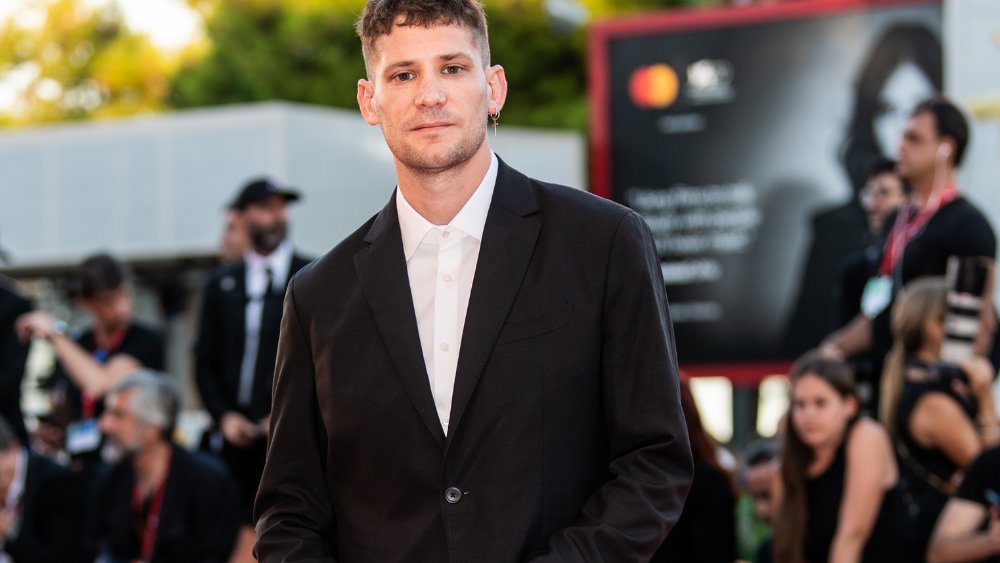
Four years after “Blanquita” won the Silver Lion for best screenplay, Chilean director Fernando Guzzoni returns to Venice. The filmmaker is set to present his latest project, “Land of the Savages,” at the Venice Gap-Financing Market, eyeing a return to the festival’s prestigious red carpet soon.
“Land of the Savages” takes place in 1850 and is set to star Édgar Ramírez (“Zero Dark Thirty”) and Nahuel Pérez Biscayart (“120 Beats Per Minute”) as Elías and Francisco. The former is a powerful slave-owning businessman haunted by sinister nightmares of a dark past; the latter, a controversial abolitionist. Both men are trapped in a spiral of corruption, betrayal and death as Guzzoni’s drama broaches Chile’s little-known history of enslavement.
“The idea first came to me because there was a wave of Haitian immigration in Chile,” Guzzoni tells Variety. “That wave led to a very striking xenophobic and racist reaction by a lot of the country, including physical aggression. This made me wonder whether there was a history of Blackness in Chile because before this immigration wave, there were not a lot of Black people in Chile — at least not like in neighboring countries like Brazil and Colombia.”
Guzzoni says that he went on a deep research period, where he learned about his own country’s past of enslavement and the horrors committed against Black people on Chilean land. “Three centuries of slavery that were entirely erased from our official history,” he notes. “No schools, private or public, teach kids about this part of our history. This seemed ludicrous to me, so I continued to investigate, and I came upon a very specific, very precise history of trafficking and exploitation of Black and Afro-Caribbean populations in Chile.”
“This was key to the formation of the Chilean elites, which triggered the idea for the film: this investigation of how a supposedly white European identity is built and what has to be erased for that to stand as the truth,” he emphasizes.
Casting Ramírez felt a natural choice for the director. The two have known each other previously, and when the Venezuelan actor heard more about the story behind “Land of the Savages,” he was “very intrigued by it.”
“Édgar shares this political interest and this social sensibility regarding the history of our continent and culture,” says Guzzoni. “He felt very moved by how the film broached an issue that permeates our countries and, to me, he is a fascinating actor and precisely the protagonist we needed, someone who is sensitive while having a very strong physical presence.”
Pérez Biscayart, then, felt a perfect counterpart to the rough physicality of the “Carlos” actor.
“Nahuel will play a character who belongs to the bourgeoisie, who was educated in France and returns to Chile to find himself facing complicated contradictions when his class power is threatened by the prospect of abolition,” notes Guzzoni. “He has a very striking sensibility and the ability to build a complex character without resorting to caricature. I am very interested in how both of them represent physical opposites, a certain sophistication in Nahuel’s character, juxtaposed to Edgar’s raw masculinity.”
The director believes “Land of the Savages” is an “encapsulation of how power has been constructed in Latin America.” “It doesn’t matter if the elite is progressive or conservative, reactionary or liberal; at the end of the day, they are a homogeneous group bound by a desire to completely exclude minorities from any sliver of power in order to sustain their social rankings.”
Chief executive officer at Foton Pictures Carlos E. Cuscó says they are focused on finishing the financing process and finding a European co-producer. “These very important films are becoming ever harder to make,” he notes. “It’s crazy. There was a very small window we got to enjoy back in 2017 when the streaming war sort of heated up, but now everybody has pulled back. Art has gotten less important to them and harder to make. We’ve been working on this project since 2022; it’s been a long journey, but we’ve finally been able to gain traction.”
“We feel the industry is ramping back up. Europe has recovered nicely in many aspects,” he continues on a more positive note. “We want to have a European piece to the film, and are looking for a European cast as well. We are trying to give Fernando all the resources he needs to fulfill his vision, because we very much believe in what he’s doing.”
Guzzoni also highlights how the industry is more open and actively leaning toward South American films dealing with the continent’s troubled political past. “Films that have a strong political message are no longer rebuffed by audiences,” he says. “It’s the contrary.”
“I like the idea of looking at how all the political fissures of the past century are rooted in this maligned conception of our republic,” he continues. “It is almost like an original sin. It is also interesting to look at how, even though many things have improved, there are still some of the same fractures plaguing us today. Édgar’s character, for example, exists in direct dialogue with the far-right movements we are seeing across the world right now, and Nahuel’s stands for the hypocritical progressists.”
The director wraps up by saying this is a film with “great audience potential.” “We can see ourselves being back in Venice, but we also don’t want it to be solely a festival film; we want it to exist in both auteur and popular spaces. We don’t want to be overly didactic; we want the story to connect to audiences.”
“Land of the Savages” is produced by Oso Films in co-production with Foton Pictures.
About The Author


